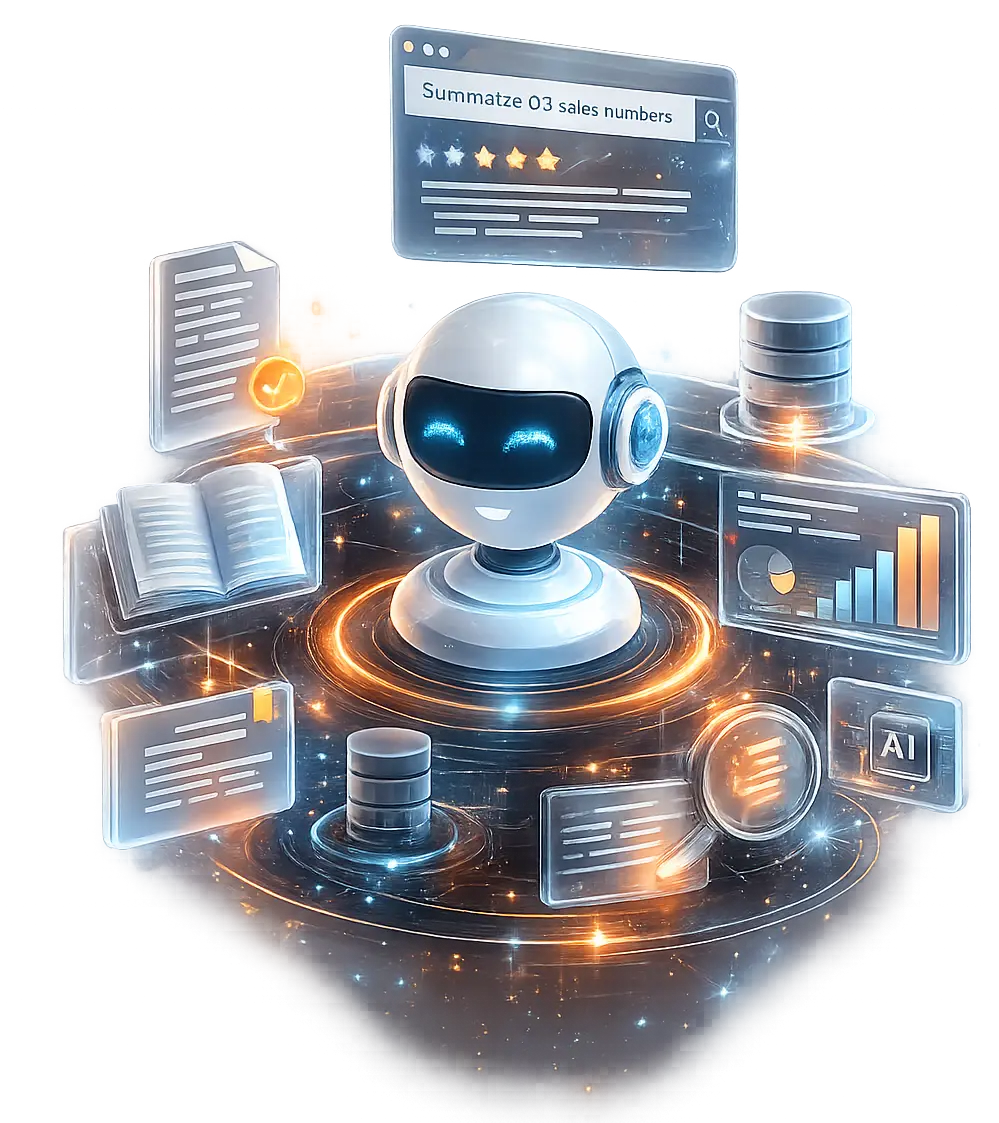
RAG Knowledge Assistants

RAG Knowledge Assistant Development Services

Build AI assistants that answer from your company documents, PDFs, websites, knowledge bases, SOPs, policies and databases. We help businesses create source-grounded RAG assistants with citations, access control, refresh pipelines and practical workflows for teams and customers.

DocumentsEmbeddingsVector SearchCitationsRBACFeedback

RAG Knowledge Assistant

Ask your company knowledge

CITED AI
1
Question
User asks in natural language
2
Retrieve
Find relevant sources and sections
3
Answer
Generate a grounded response
4
Cite
Show source documents and references
SOURCESRETRIEVAL + LLMANSWERCITATIONS + LOGS
Source-Grounded

Answers are generated from approved documents, websites, databases and knowledge sources instead of relying only on model memory.

Permission-Aware

Assistants can respect user roles, departments, document groups and access rules so teams only see the knowledge they are allowed to use.

Cited Answers

Responses can include references to the source document, section, page, policy or record so users can verify important information.

Continuously Updated

Knowledge can be refreshed from new documents, CMS content, product pages, SOPs, policies, FAQs and internal repositories.

Source-grounded AI

What is a RAG knowledge assistant?

RAG knowledge assistant

A RAG knowledge assistant is an AI system that searches your approved knowledge sources before it answers. Instead of guessing from general model memory, it retrieves the most relevant content from your documents, web pages, records or knowledge base.

This makes the assistant useful for business questions where accuracy, context and verification matter. Users can ask naturally, while the system finds relevant sections and prepares an answer with references.

Srishta Technology designs RAG assistants for real workflows: internal knowledge search, support teams, healthcare operations, HR policies, sales enablement, compliance documents and customer-facing help experiences.

Before vs After

Turn scattered knowledge into answers your teams can trust

RAG works best where teams already have useful content but people waste time finding it, interpreting it or verifying whether it is still correct.

Scattered documents

Without RAG

Employees search across folders, PDFs, drives, emails, websites and old links to find one answer.

With RAG assistant

A RAG assistant searches approved knowledge sources and returns a concise answer with references.

Unverified answers

Without RAG

Teams rely on memory, old documents or informal messages that may be incomplete or outdated.

With RAG assistant

Answers are grounded in selected sources, with citations that help users verify important details.

Slow support handling

Without RAG

Support teams spend time locating product details, policies and troubleshooting steps before replying.

With RAG assistant

Agents receive source-backed answer drafts, summaries and escalation guidance inside the support workflow.

Knowledge gaps stay hidden

Without RAG

Managers do not know which questions are frequently unanswered or which documents are confusing.

With RAG assistant

Analytics show missing content, low-confidence queries, common questions and documents that need updates.

Knowledge Assistant Solutions

RAG assistants we build for business teams

Each assistant is designed around a specific knowledge workflow, user group and access model instead of being a generic chatbot connected to a folder.

Internal Knowledge Assistant

Give employees one place to ask questions across policies, SOPs, training documents, project notes, internal guides and company knowledge repositories.

Search across approved internal documents
Answer with source references
Summarize long policies and SOPs
Support department-wise access control
Reduce repeated questions to managers and support teams
Keep answers aligned with the latest uploaded knowledge

Customer Support Knowledge Assistant

Help support teams answer faster by retrieving product details, troubleshooting steps, service policies, FAQs and previous knowledge-base content.

Support answer suggestions with citations
Troubleshooting and product guidance retrieval
Ticket context summarization
Escalation when confidence is low
Approved response drafting for agents
Knowledge gaps reported back to admins

Healthcare Knowledge Assistant

Support healthcare workflows by helping staff search approved operational documents, care instructions, consultation notes, lab booking rules and patient communication templates.

Healthcare SOP and workflow lookup
Consultation note and summary assistance
Lab booking process references
Patient communication guidance
Role-aware access for staff workflows
Human review for sensitive outputs

HR & Policy Assistant

Let employees ask questions about leave, onboarding, benefits, company policies, IT access, reimbursements and internal procedures without searching multiple PDFs.

Employee policy Q&A
Onboarding and joining support
Leave, reimbursement and HR workflow answers
Source-backed policy references
Department-specific access rules
HR escalation for unclear or sensitive questions

Sales & Product Knowledge Assistant

Help sales and account teams find the right product details, service fit, pricing references, proposal inputs, case studies and technical explanations quickly.

Product and service knowledge retrieval
Proposal and RFP input assistance
Case study and capability lookup
Objection-handling knowledge support
Sales enablement document search
CRM and lead context integration options

Compliance & Document Review Assistant

Assist legal, compliance and operations teams with controlled document search, clause lookup, policy comparison, due-diligence preparation and evidence-backed summaries.

Contract and policy search
Clause and requirement lookup
Document comparison support
Due-diligence response preparation
Audit-ready source references
Review queues for important decisions
Core Capabilities

What makes a RAG assistant production-ready

A useful RAG assistant needs more than uploaded files. It needs clean ingestion, retrieval quality, citations, permissions, fallback logic and knowledge maintenance.

Knowledge Ingestion

Import PDFs, docs, web pages, CMS content, help articles, SOPs, product sheets, policies, database records and internal files.

Chunking & Structuring

Split large documents into usable sections with metadata such as source, department, page, category, date, owner and access level.

Embeddings & Vector Search

Convert knowledge into searchable representations so the assistant can find relevant meaning even when users ask in different words.

RAG Answer Generation

Retrieve the right context first, then generate answers that are grounded in approved company knowledge and business rules.

Source Citations

Show document names, page references, links, sections or record IDs so users can confirm where the answer came from.

Role-Based Access

Restrict knowledge by team, role, department, tenant, geography, project or user group before retrieval and response generation.

Fallback & Escalation

Handle missing, outdated, uncertain or restricted information by asking follow-up questions or escalating to the right human team.

Knowledge Operations

Track unanswered questions, outdated content, usage patterns, feedback, source quality and opportunities to improve the knowledge base.

Implementation Process

A structured approach from documents to deployable assistant

We start by understanding knowledge quality and user needs, then design retrieval, citations, permissions and feedback loops before rollout.

01

Knowledge Audit

We review your documents, websites, FAQs, databases, SOPs, policies and internal knowledge sources to understand quality, ownership and access rules.

02

Use Case & Access Design

We define who will use the assistant, what they can ask, which sources are allowed, where citations are needed and when human review is required.

03

Ingestion Pipeline

We create the ingestion flow for documents and data, including parsing, cleaning, chunking, metadata tagging, indexing and refresh strategy.

04

Retrieval & Prompt Design

We design retrieval logic, ranking, filters, prompts, answer format, source attribution and fallback behavior for unanswered questions.

05

Testing & Evaluation

We test the assistant against real questions, edge cases, outdated files, restricted documents, hallucination risk and source quality.

06

Deployment & Improvement

We deploy the assistant into your website, app, internal portal or dashboard, then monitor feedback, gaps, usage and content health.

Architecture

RAG knowledge assistant architecture

The architecture connects knowledge sources, ingestion pipelines, retrieval logic, LLM response generation, permissions and monitoring into one controlled system.

Knowledge Sources

PDFsDocsWebsiteDatabaseHelp centerSOPs

Ingestion Layer

ParsingCleaningChunkingMetadataRefresh jobsVersioning

Retrieval Layer

EmbeddingsVector searchHybrid searchFiltersRankingAccess checks

Answer Layer

LLMPrompt rulesCitationsFallbacksClarifying questionsHuman handoff

Governance Layer

RBACAudit logsFeedbackQuality reviewAnalyticsCost tracking
Governance

Designed for trust, access control and content quality

For business use, a RAG assistant must be careful about what it retrieves, who can access it and when it should avoid answering.

Source control and approval

Only approved knowledge sources should be indexed for production assistants. Draft, expired or restricted content can be excluded or routed for admin review.

Role-aware retrieval

The assistant should filter knowledge before answering so employees, customers, doctors, admins or partners receive only information they are permitted to access.

Citation-first answers

Important answers should show where the information came from. This improves trust and makes the assistant useful for serious business workflows.

Feedback and gap tracking

Every unanswered question, negative rating and low-confidence answer can become a signal to improve documents, FAQs, SOPs and assistant behavior.

Use Cases

RAG assistant use cases

RAG can support internal teams, customer-facing experiences and admin workflows wherever answers need to come from trusted company knowledge.

Company document search assistant
Internal policy and SOP assistant
Customer support knowledge assistant
Healthcare staff knowledge assistant
Doctor consultation summary support
Lab booking process assistant
HR policy and onboarding assistant
Product knowledge assistant for sales teams
Proposal and RFP response assistant
Legal and compliance document search
Training material Q&A assistant
PDF and manual question answering
Knowledge-base chatbot for websites
Admin dashboard knowledge assistant
Multi-department enterprise assistant
Source-backed executive summary assistant
Technology Stack

RAG, LLM and backend capabilities

We select the right architecture based on your data volume, security needs, accuracy expectations, latency, cost and integration requirements.

LLMs & AI

OpenAIClaudeGeminiOpen-source LLMsEmbeddingsPrompt workflows

RAG Stack

Vector databasesHybrid searchSemantic searchChunkingMetadata filtersRetrieval ranking

Knowledge Sources

PDFsDOCXWeb pagesCMSDatabasesKnowledge basesHelp centersInternal files

Backend & APIs

PythonFastAPINode.jsJava Spring BootREST APIsPostgreSQLRedisAuthentication

Governance

RBACTenant isolationAudit logsAdmin reviewFeedback captureSource versioning

Deployment

AWSAzureGoogle CloudDockerCI/CDMonitoringLoggingCost tracking
Industries

Where RAG knowledge assistants create value

The strongest use cases usually appear where teams already have lots of useful content but struggle to access it quickly and consistently.

Healthcare

Explore →

Create knowledge systems for patient support, internal protocols, care workflows, lab processes, appointment guidance and healthcare operations.

Patient FAQsCare workflowsHealthcare SOPs

SaaS & Technology

Explore →

Build product documentation, help centers, release-note knowledge and support agent assistants for software platforms.

Product docsAPI guidesSupport content

HR & Enterprise Teams

Explore →

Give employees quick access to policies, onboarding material, IT help, admin processes and department-level information.

HR policiesOnboardingInternal support

Education

Explore →

Organize learning resources, student support content, training materials and educational workflows.

Learning resourcesStudent supportTraining content

Manage product FAQs, customer support knowledge, catalog information and retail operations efficiently.

Product FAQsCustomer supportCatalog data

Manufacturing

Explore →

Document SOPs, quality processes, maintenance guidance and operational instructions for teams.

SOPsSafety guidesProcess notes

Enterprise AI

Explore →

Deploy AI-powered knowledge systems, automation workflows and intelligent enterprise assistants.

AI assistantsAutomationKnowledge systems

Government Projects

Explore →

Build secure information systems for public services, citizen support and administrative workflows.

Citizen servicesPublic workflowsSecure systems

Media & Entertainment

Explore →

Organize content libraries, audience support systems and media operations with intelligent solutions.

Content systemsMedia workflowsAudience support
Book a discussion

Plan your RAG knowledge assistant

Share your knowledge sources, users and goals. We will help you identify a practical first use case, the right sources to connect and the governance controls needed before development.

Identify the knowledge sources to connect first
Define user roles, access rules and answer expectations
Review citations, governance and content refresh needs
Plan a practical pilot before full enterprise rollout
FAQ

Frequently Asked Questions

A RAG knowledge assistant is an AI assistant that retrieves relevant information from approved documents, websites, databases or knowledge bases before generating an answer. This makes responses more grounded and useful for business questions.
A normal chatbot may answer from general model knowledge or fixed scripts. A RAG assistant searches your actual business content first, then answers using that context with source references when required.
Yes. We can build assistants that search PDFs, DOCX files, web pages, help centers, SOPs, policies, manuals, product sheets and selected database records.
Yes. We can include document names, page references, source links, section titles or record IDs so users can verify important answers.
Yes. We can design role-based retrieval so users only receive answers from documents and sources they are allowed to access.
Yes. RAG assistants can be added to websites, mobile apps, admin dashboards, support panels, internal portals and business tools through APIs or widgets.
The assistant can say that the information is not available, ask a clarifying question, suggest related sources or escalate to a human team instead of guessing.
Start with a knowledge discovery call. We review your documents, users, access rules and business goals, then suggest the right RAG architecture and rollout plan.
Build source-grounded AI

Turn your documents, policies and knowledge base into a reliable AI assistant

Whether you need internal document search, customer support knowledge, healthcare workflow assistance or a role-aware enterprise assistant, Srishta Technology can help you build a RAG solution that is practical, secure and ready for real users.

Explore AI Implementation