How We Built an AI-Powered Knowledge Assistant Using RAG for a Multi-Department Enterprise

Shailesh Maurya is a Full-Stack Software Developer specializing in React, Node.js, and scalable backend solutions. He builds high-performance web applications with a strong focus on user experience, reliability, and clean architecture. He also has experience in RAG development, working with LLMs such as Ollama and ChatGPT, along with vector databases like PGVector to build intelligent AI-powered solutions.
Overview
A growing enterprise with multiple departments faced a common challenge: critical business information was distributed across PDFs, spreadsheets, internal portals, SOP documents, HR policies, technical manuals, and shared drives.
Employees spent significant time searching for information, resulting in reduced productivity, delayed decision-making, and increased dependency on support teams.
The company approached Srishta Technology to develop an AI-powered knowledge assistant capable of understanding natural language questions and retrieving accurate answers from internal company data.
To solve this problem, we implemented a Retrieval-Augmented Generation (RAG) architecture that combined enterprise search, vector databases, and large language models.
Challenges
The client experienced several operational issues:
- Knowledge scattered across multiple systems and document repositories
- Employees spending excessive time searching for information
- Repeated support requests regarding policies and procedures
- Difficulty onboarding new employees
- Outdated search systems returning irrelevant results
- Lack of centralized knowledge access
- Growing volume of documentation making manual search inefficient
Our Solution
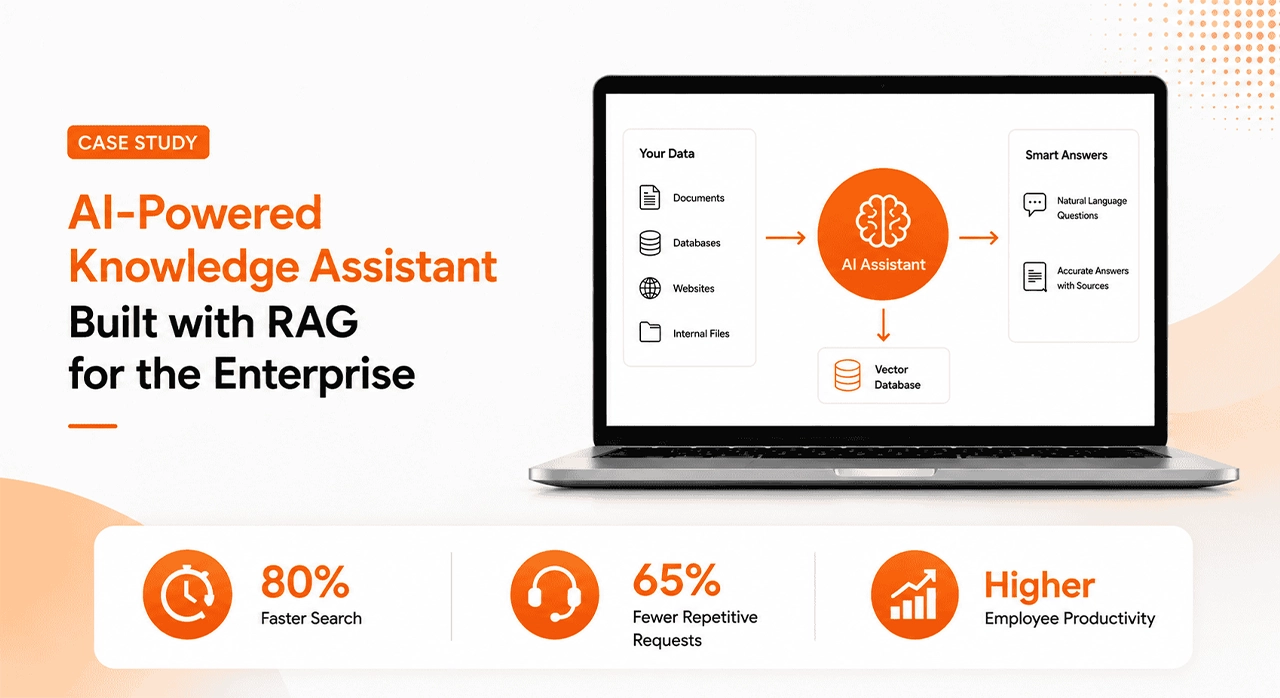
We designed and developed a custom RAG platform that enabled employees to ask questions in natural language and receive context-aware responses backed by company data.
Key Components
Data Ingestion Pipeline
We built automated ingestion pipelines that processed:
- PDF documents
- HR policies
- SOP manuals
- Technical documentation
- Internal wiki content
- Knowledge base articles
- Shared drive content
The system automatically cleaned, chunked, embedded, and indexed the content for retrieval.
Vector Search Infrastructure
We implemented a vector database architecture that allowed semantic search instead of traditional keyword matching.
This enabled users to find information based on meaning and context rather than exact keywords.
Large Language Model Integration
The retrieval layer was integrated with a modern large language model capable of:
- Understanding user intent
- Retrieving relevant knowledge
- Generating concise responses
- Citing information sources
- Maintaining conversational context
Secure Access Control
The solution included:
- User authentication
- Role-based permissions
- Department-level access restrictions
- Audit logging
- Query tracking
- Source verification
Development Process
Phase 1: Discovery & Planning
We analyzed:
- Existing documentation systems
- User workflows
- Security requirements
- Knowledge access patterns
- Search behavior
Phase 2: Architecture Design
We designed:
- Document ingestion workflows
- Embedding strategy
- Vector database architecture
- Retrieval pipeline
- LLM integration layer
Phase 3: Prototype Development
A pilot system was developed using a subset of company documents to validate:
- Retrieval quality
- Response accuracy
- Search performance
- User experience
Phase 4: Full Deployment
The complete platform was deployed with:
- Production infrastructure
- Monitoring systems
- Analytics dashboards
- Security controls
- Automated document synchronization
Results
Within the first few months of deployment, the organization reported significant improvements.
Business Impact
- 80% reduction in time spent searching for information
- 65% decrease in repetitive internal support requests
- Faster employee onboarding process
- Improved knowledge accessibility across departments
- Better utilization of existing company documentation
- Increased employee productivity
Technical Improvements
- Sub-second semantic document retrieval
- High answer relevance across departments
- Automatic knowledge updates
- Scalable architecture supporting thousands of documents
- Secure access management
Technologies Used
AI & LLM
- OpenAI GPT
- Anthropic Claude
- Meta Llama
RAG Frameworks
- LangChain
- Custom Retrieval Pipelines
Vector Databases
- Pinecone
- Qdrant
Backend
- Node.js
- Python
Cloud Infrastructure
- AWS
- Docker
- Kubernetes
Key Features Delivered
- AI-powered knowledge assistant
- Enterprise document search
- Multi-document question answering
- Source-backed responses
- Semantic search capabilities
- Automated document ingestion
- Access control and permissions
- Usage analytics dashboard
- Continuous knowledge synchronization
Conclusion
By implementing a Retrieval-Augmented Generation (RAG) solution, we transformed fragmented enterprise knowledge into a centralized AI-powered assistant.
Employees can now access information instantly through natural language conversations instead of manually searching through hundreds of documents.
The result is faster decision-making, improved productivity, reduced operational overhead, and a scalable foundation for future AI initiatives.
If your organization wants to unlock the value of internal knowledge using AI, our RAG Development Services can help you design, build, and deploy a secure enterprise-grade solution.