Radiation Oncologist Annotation Service Provider


Oliver Thomas is a passionate developer and tech writer. He crafts innovative solutions and shares insightful tech content with clarity and enthusiasm.
Are you looking for a reliable radiation oncology data annotation service provider that can work with complex CT and MRI datasets, follow specific contouring protocols, provide expert-reviewed annotations, and deliver outputs compatible with radiotherapy workflows?
Developing AI for radiation oncology requires much more than conventional medical image labeling.
Whether you are developing an AI solution for radiotherapy treatment planning, automatic contouring, tumor segmentation, organ-at-risk segmentation, medical image analysis, or radiation oncology clinical decision support, the quality of your training data can directly affect the performance of your model.
This is where Srishta Technology Private Limited can support organizations looking for specialized radiation oncology data annotation services, radiotherapy annotation services, medical image segmentation, and expert-reviewed AI training data.
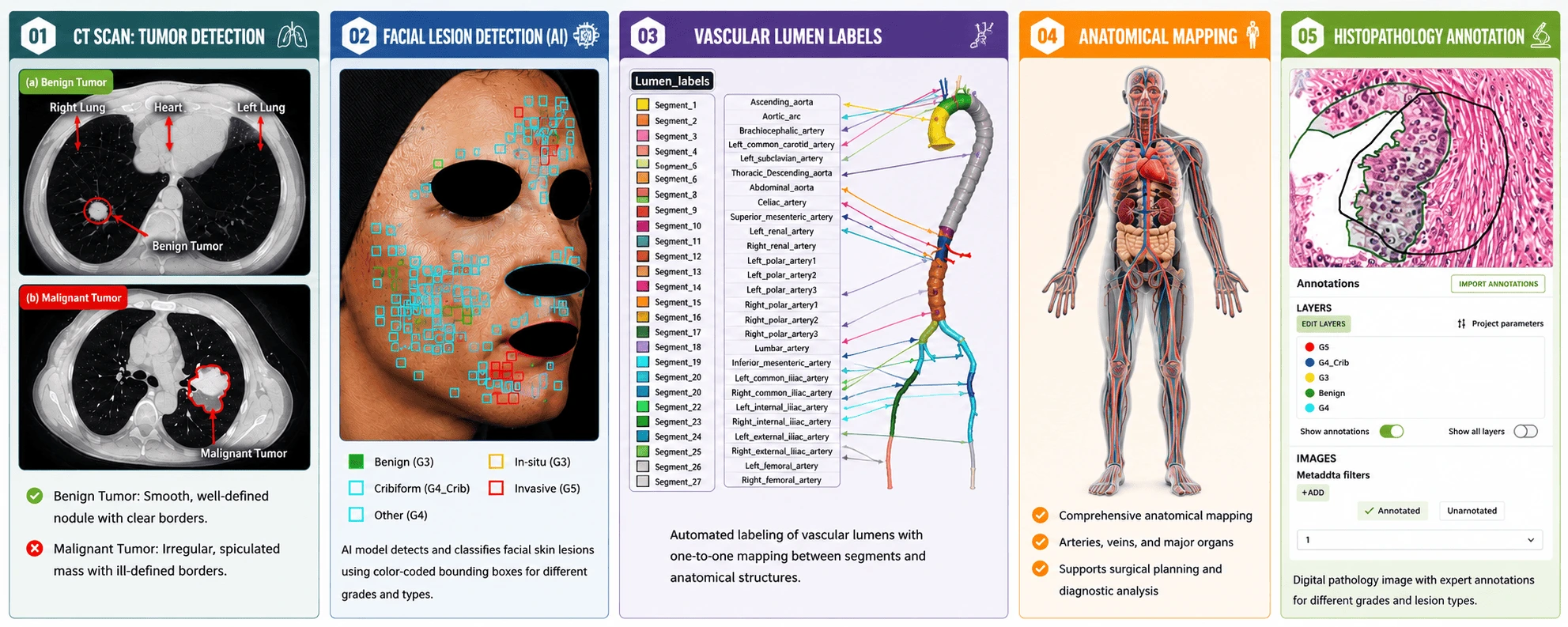
With experience in complex data annotation projects and collaborations supporting Fortune 500 organizations and clients across global markets, Srishta Technology brings together scalable annotation operations, domain-focused resources, structured quality assurance, and client-specific workflows.
Radiation oncology datasets can require a combination of medical-domain understanding, precise 3D segmentation, contouring-protocol compliance, expert review, quality control, traceability, and radiotherapy-compatible outputs.
Srishta Technology can build an annotation workflow around these project-specific requirements.
What Types of Radiation Oncology Datasets Can We Support?
Radiation oncology AI projects can involve multiple imaging modalities, sequences, anatomical regions, and contouring requirements.
Depending on the project, datasets may include:
CT and MRI
We can support projects involving:
- CT scans
- MRI scans
- CT/MRI-based radiotherapy datasets
- Multimodal medical imaging datasets
- Treatment-planning imaging datasets
These datasets may be used for radiotherapy AI data annotation, medical image segmentation, tumor contouring, organ segmentation, and AI model training.
Multiple MRI Sequences
Depending on the indication and project requirements, datasets may contain multiple MRI sequences.
Annotation workflows can be configured according to the imaging sequences supplied, annotation objectives, target structures, and client guidelines.
This is particularly important when anatomical or pathological structures need to be interpreted across multiple imaging sequences.
Multiple Anatomical Regions
Srishta Technology can structure annotation projects involving areas such as:
- Head & Neck
- Brain
- Pelvis
- Thorax
- Other anatomical regions defined by the project
Each anatomical region can have different organs at risk, target structures, contouring challenges, and clinical protocols.
For this reason, the annotation taxonomy and quality-assurance process should be established before production begins.
Radiotherapy Contouring and 3D Segmentation Services
A major requirement in radiation oncology AI is the creation of accurate anatomical and target-volume contours.
Depending on project requirements, Srishta Technology can support 3D medical image segmentation and radiotherapy contouring annotation workflows.
Potential annotation tasks include:
- Tumor segmentation
- Tumor contouring
- Tumor delineation
- Target volume segmentation
- Organ segmentation
- Organ-at-risk segmentation
- Radiotherapy contouring
- Treatment-planning contour annotation
- CT segmentation
- MRI segmentation
- 3D medical image segmentation
The required structures and contouring rules should be defined according to the client's approved protocol.
Top Data Labeling Companies in United States 2026
GTV, CTV and PTV Annotation Services
Radiation oncology datasets may require annotation of different target volumes used in treatment planning.
These can include:
Gross Tumor Volume – GTV Annotation
GTV annotation services can involve identifying and contouring the grossly visible or demonstrable tumor according to the project-specific clinical guidelines.
Clinical Target Volume – CTV Annotation
CTV annotation services can involve contouring the clinical target volume according to the supplied protocol and clinical criteria.
Planning Target Volume – PTV Annotation
Where required by the project workflow, PTV annotation services can support structured target-volume datasets for radiotherapy applications.
Together, GTV, CTV and PTV annotation services can support the creation of structured datasets for radiation oncology AI development.
Because target-volume definitions are clinically sensitive and indication-specific, projects should use clearly established contouring protocols and the appropriate level of qualified expert review.
Organ at Risk – OAR Segmentation Services
Organ at risk segmentation, commonly referred to as OAR segmentation, is another important area for radiotherapy AI.
Depending on the anatomical site and client protocol, relevant organs and structures can be segmented within CT or MRI scans.
Potential applications include:
- OAR segmentation for radiotherapy
- Organ-at-risk annotation
- Automated contouring AI training
- Radiation treatment planning AI
- Medical image segmentation
- Dose-planning research
- Radiotherapy workflow automation
The exact OAR classes can be defined by the client according to the anatomical region and clinical application.
Can We Work According to Existing Contouring Guidelines?
Yes.
For radiation oncology projects, we recommend using the client's established and clinically approved contouring guidelines or protocols whenever available.
These guidelines can define:
- Target structures
- Organ-at-risk structures
- Inclusion and exclusion criteria
- Anatomical boundaries
- GTV/CTV/PTV definitions
- Naming conventions
- Imaging sequences to reference
- Contouring methodology
- Edge-case handling
- Required output format
- Quality-acceptance criteria
Rather than creating clinical contouring rules independently, Srishta Technology can configure the annotation and QA workflow around the client's approved guidelines and project specifications.
If guidelines require clarification, ambiguous cases can be identified during the pilot/calibration phase and resolved with the client's clinical team before large-scale production.
Ophthalmology Data Annotation Service provider for AI
3D Segmentation Outputs for Radiotherapy Workflows
Radiotherapy projects frequently require more than conventional 2D polygons or image masks.
From a technical perspective, projects may require 3D segmentation outputs compatible with radiotherapy workflows.
Depending on the client's technical environment and specifications, this can include workflows involving:
DICOM imaging → 3D annotation/contouring → QA → Expert review → Structured radiotherapy-compatible output
Where required and supported by the agreed technical workflow, outputs can be prepared for compatibility with formats such as DICOM-RTSTRUCT.
Technical output requirements should be validated during the pilot stage to ensure compatibility with the client's downstream radiotherapy or machine-learning pipeline.
Expert / Radiation Oncologist Annotation
Some radiation oncology annotation tasks require specialist clinical expertise.
Srishta Technology can structure projects to incorporate expert or radiation oncologist annotation/review where the project requires that level of clinical expertise and suitable qualified resources are engaged for the scope.
Potential workflows include:
Medical Annotator → Radiation Oncology Expert Review → QA
or, for higher-assurance requirements:
Expert Annotation → Independent Expert Review → Adjudication → Final Ground Truth
The appropriate workflow depends on the complexity, intended use, regulatory context, and ground-truth requirements of the project.
Double Reading and Independent Review
For high-quality medical AI datasets, a single annotation pass may not be sufficient.
Srishta Technology can design a double-reading or independent-review workflow where required.
For example:
Radiation Oncologist / Expert A
↓
Independent Expert B
↓
Agreement Check
↓
Discrepancy Identification
↓
Adjudication
↓
Final Annotation

This provides a structured mechanism for detecting disagreements and improving consistency in the final dataset.
Adjudication in Case of Discrepancies
Clinical annotation is not always completely objective.
Two qualified reviewers may interpret a boundary differently, particularly in challenging or ambiguous cases.
Instead of hiding these disagreements, a strong ground-truth workflow should identify them.
Srishta Technology can support an adjudication process such as:
Annotation A + Annotation B → Comparison → Discrepancy Flagging → Expert Adjudication → Final Ground Truth

The exact adjudication rules and responsible clinical experts can be agreed with the client before production.
Quality Control and Annotation Traceability
For radiation oncology datasets, quality assurance is particularly important.
Depending on project requirements, the quality workflow can incorporate:
- Annotator-level checks
- Independent review
- Double reading
- Expert review
- Discrepancy tracking
- Adjudication
- Guideline-compliance checks
- Annotation status tracking
- Version control
- Correction tracking
- Reviewer traceability
- Final QA checks
This creates a more transparent annotation lifecycle.
A typical workflow can look like:
Dataset Intake
↓
Guideline & Taxonomy Review
↓
Pilot Annotation
↓
Client Calibration
↓
Production Annotation
↓
Independent / Expert Review
↓
Discrepancy Resolution
↓
Adjudication, if required
↓
Technical QA
↓
Final Delivery

Client-Specific Contouring Guidelines
Every radiation oncology AI project is different.
For this reason, Srishta Technology can work according to client-specific contouring guidelines instead of applying a one-size-fits-all annotation taxonomy.
This can cover requirements such as:
- Specific anatomical boundaries
- Disease-specific target definitions
- GTV rules
- CTV definitions
- PTV specifications
- OAR definitions
- CT/MRI reference requirements
- MRI sequence selection
- Structure naming
- Annotation conventions
- Difficult-case escalation
- QA criteria
- Output specifications
A pilot is recommended before full-scale annotation.
This allows the client's clinical experts and Srishta's annotation team to calibrate on difficult cases and resolve ambiguities before scaling production.
Why Choose Srishta Technology for Radiation Oncology Data Annotation?
Medical AI annotation demands accuracy, scalability, confidentiality, technical capability, and domain-specific expertise.
Srishta Technology brings experience from complex annotation projects and has collaborated with Fortune 500 organizations and clients across global markets.
Our approach focuses on combining structured project management with the appropriate domain expertise for each project.
Experience with Complex Data Annotation Projects
Srishta Technology has experience managing specialized annotation requirements where accuracy, consistency, and detailed client guidelines are critical.
This operational experience can be adapted to medical imaging and radiation oncology annotation workflows.
Experience Working with Global Organizations
Having collaborated with Fortune 500 organizations and clients across the globe, our team understands the importance of:
- Defined annotation guidelines
- Confidentiality
- Consistent communication
- Quality assurance
- Scalable operations
- Project traceability
- Delivery schedules
- Client-specific requirements
Medical-Domain Resources
For medical annotation projects, Srishta Technology can assemble teams based on the expertise required for the scope, including medically trained professionals and appropriate specialist review where required.
Pilot Before Large-Scale Production
We recommend beginning complex radiation oncology projects with a pilot.
Our approach is:
Requirement Analysis → Guideline Review → Pilot Annotation → Client Calibration → Production → Multi-Level QA → Expert Review → Delivery

The pilot helps establish annotation expectations and provides an opportunity to measure quality before scaling.
Custom Workflow Instead of Generic Annotation
We do not assume that every medical imaging project should follow the same workflow.
A project involving brain tumor segmentation can have very different requirements from Head & Neck OAR segmentation or pelvic radiotherapy contouring.
The annotation team, taxonomy, review process, and output structure can therefore be configured around each project.
Radiation Oncology AI Training Data Services
High-quality annotated datasets can support AI and machine-learning applications such as:
- Automatic organ segmentation
- Automatic tumor segmentation
- Auto-contouring
- Treatment-planning assistance
- Target-volume delineation
- OAR detection and segmentation
- Medical image analysis
- Radiation oncology workflow automation
- AI-assisted radiotherapy planning
- Oncology research
- Computer vision model development
Srishta Technology can support the transformation of raw medical imaging datasets into structured radiation oncology AI training data.
From Raw CT/MRI Data to AI-Ready Radiation Oncology Data
A typical project can move through the following stages:
This workflow can be customized according to the project's clinical and technical requirements.
Frequently Asked Questions About Radiation Oncology Data Annotation
What is radiation oncology data annotation?
Radiation oncology data annotation is the process of creating structured labels, contours, segmentations, classifications, or other ground-truth information from medical datasets such as CT and MRI scans for applications including radiotherapy, medical AI, machine learning, and treatment-planning research.
Who provides radiation oncology data annotation services?
Specialized medical data annotation companies can provide radiation oncology annotation services. Projects involving clinical interpretation should incorporate appropriately qualified medical experts or radiation oncologists according to the complexity and intended use of the annotations.
Is Srishta Technology a radiation oncology data annotation company in India?
Srishta Technology Private Limited is an India-based data annotation company that supports specialized medical data annotation requirements. Radiation oncology projects can be structured around client-defined imaging, contouring, QA, expert-review, and technical-output requirements.
Can radiation oncologists review the annotations?
Where required by the project, workflows can be designed to include qualified radiation oncologist or relevant specialist review, subject to agreed project scope and resource availability.
Do you provide GTV, CTV and PTV annotation services?
Projects can be configured for GTV, CTV and PTV annotation according to client-provided clinical definitions, contouring protocols, imaging data, and expert-review requirements.
Do you provide OAR segmentation services?
Yes, projects can include organ-at-risk (OAR) segmentation for radiotherapy according to the anatomical region and client-defined contouring protocol.
Can you annotate CT and MRI datasets?
Yes. Medical imaging annotation workflows can be developed for CT and MRI datasets, including projects involving multiple MRI sequences depending on the indication and requirements.
Which anatomical regions can be supported?
Projects may involve Head & Neck, brain, pelvis, thorax, and other anatomical regions. The feasibility, required expertise, and annotation protocol should be assessed for each project before production.
Can you work with multiple MRI sequences?
Yes. Where multiple MRI sequences are provided, the annotation workflow can be configured around the sequences specified in the client's protocol and annotation instructions.
Can you follow our existing contouring guidelines?
Yes. Working from client-approved contouring guidelines is the preferred approach. The guidelines can be reviewed during project onboarding and validated through pilot annotation and calibration.
Can you create 3D segmentation for radiation therapy?
Projects can include 3D medical image segmentation for radiotherapy applications. The exact annotation methodology, structures, output requirements, and expert-review process should be established before production.
Can annotations be delivered in DICOM-RTSTRUCT format?
Where DICOM-RTSTRUCT is part of the agreed technical workflow, output compatibility can be incorporated into the project requirements. A pilot should first validate that the generated output integrates correctly with the client's radiotherapy or downstream technical environment.
Do you support double reading?
A project can be configured with double reading or independent expert review, depending on the required level of quality assurance.
What happens when two experts disagree on a contour?
Discrepancies can be flagged and routed through a predefined adjudication process. The final ground truth can then reflect the agreed expert decision according to the project's clinical protocol.
How do you maintain annotation quality?
Depending on project requirements, QA can include annotator checks, independent review, double reading, expert review, discrepancy tracking, adjudication, guideline-compliance checks, technical validation, and final quality control.
Can you maintain annotation traceability?
Annotation workflows can be structured to track relevant annotation and review stages, including annotation status, corrections, reviews, discrepancies, and final approval according to the client's traceability requirements and the capabilities of the agreed tooling.
Can Srishta Technology provide AI training data for radiation oncology?
Yes. Srishta Technology can support annotation workflows for creating structured radiation oncology AI training data, including tumor segmentation, target-volume annotation, OAR segmentation, medical image segmentation, and other client-defined tasks.
Why outsource radiation oncology data annotation to India?
India offers access to technical annotation teams and medical-domain talent while supporting scalable annotation operations. The suitability of any provider should ultimately be assessed based on clinical expertise, QA methodology, data-security requirements, technical compatibility, and demonstrated performance on a pilot—not location alone.
How do we start a radiation oncology annotation project?
A good starting point is to provide:
- Sample CT/MRI data
- Anatomical region and indication
- Required structures
- Existing contouring guidelines
- Required expert level
- QA and double-reading requirements
- Adjudication requirements
- Expected 3D output format
- Dataset volume
- Expected timeline
Srishta Technology can then evaluate the requirements and establish a pilot annotation and calibration workflow before full-scale production.
Looking for a Radiation Oncology Data Annotation Partner?
If you are searching for a radiation oncologist annotation service provider, radiation oncologist data annotation company in India, radiotherapy data annotation company, medical image segmentation provider, GTV/CTV/PTV annotation service, OAR segmentation provider, or radiation oncology AI training data partner, Srishta Technology can help evaluate your requirements.
Our experience working on specialized annotation projects and collaborating with Fortune 500 organizations and clients globally enables us to understand the operational discipline required for complex AI training-data programs.
Whether your project involves CT, MRI, multiple MRI sequences, Head & Neck, brain, pelvis, thorax, tumor segmentation, GTV/CTV/PTV annotation, OAR segmentation, radiotherapy contouring, 3D segmentation, DICOM-RTSTRUCT-compatible workflows, double reading, expert review, or adjudication, the annotation workflow can be designed around your requirements.
 +91 93543 34258
  +91 93543 34258