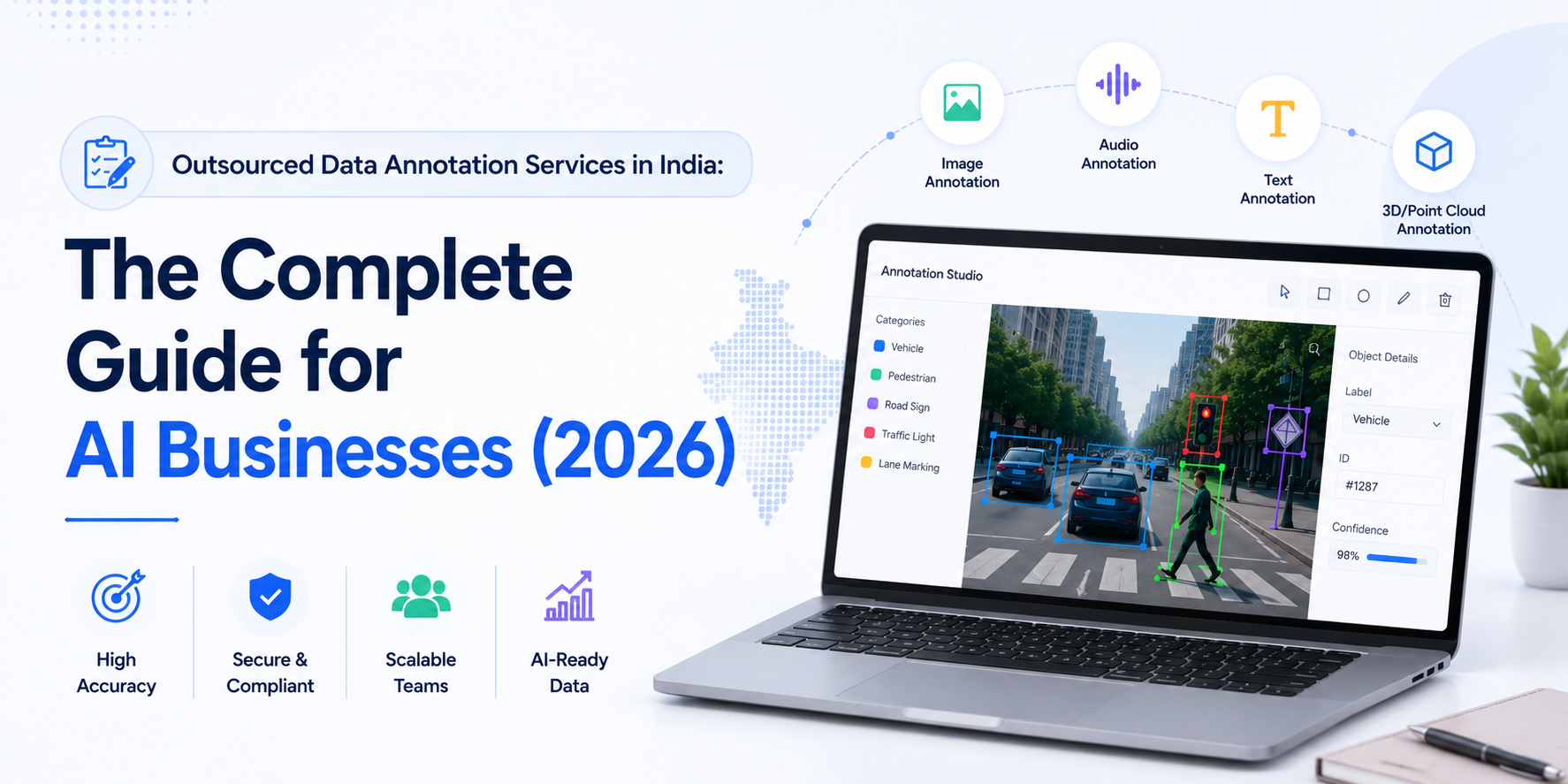
Outsourced Data Annotation Services in India: The Complete Guide for AI Businesses (2026)

Mansi Singhania — a seasoned blog author dedicated to creating high-quality, research-driven content that informs, engages, and adds lasting value across a range of topics.
Artificial Intelligence (AI) has transformed the way businesses operate, from automating customer service to enabling self-driving vehicles and improving medical diagnosis. However, behind every successful AI application lies one essential ingredient—high-quality annotated data. Without accurately labeled datasets, even the most sophisticated machine learning algorithms struggle to deliver reliable results.
As AI adoption accelerates across industries, organizations are generating enormous volumes of images, videos, text, audio, and documents that need to be labeled before they can be used for training AI models. Managing this process internally often requires significant investments in skilled professionals, infrastructure, quality assurance, and project management. For many businesses, this approach is neither practical nor cost-effective.
This is why companies across the United States, Europe, Australia, and the Middle East are increasingly choosing outsourced data annotation services in India. Indian annotation providers offer experienced teams, scalable operations, competitive pricing, and established quality control processes that enable businesses to accelerate AI development while reducing operational costs.
Whether you're building a computer vision solution, developing a natural language processing (NLP) application, or training a healthcare AI model, selecting the right data annotation partner can directly influence the performance of your AI system.
In this comprehensive guide, we'll explain what data annotation is, how outsourced annotation services work, why businesses outsource to India, the different types of annotation services available, leading data annotation companies, pricing models, and the key factors to consider when choosing an outsourcing partner.
What Is Data Annotation?
Data annotation is the process of labeling raw data such as images, videos, text, audio, or documents so that artificial intelligence (AI) and machine learning (ML) models can recognize patterns, understand context, and make accurate predictions.
Without properly labeled data, AI models cannot learn effectively. Annotation acts as the foundation that teaches algorithms how to interpret the real world.
Imagine teaching a child to identify different animals. You would show multiple pictures and explain, "This is a dog," "This is a cat," or "This is a horse." Over time, the child learns to distinguish each animal independently.
Machine learning models learn in much the same way. Instead of verbal explanations, they rely on thousands—or even millions—of accurately labeled examples. Each annotation provides the context the model needs to recognize patterns and improve its predictions over time.
The quality of these annotations directly impacts the performance of the AI model. Incorrect or inconsistent labels can introduce bias, reduce accuracy, and increase the amount of retraining required before deployment.
According to industry reports, data preparation and annotation account for nearly 60–80% of the total effort involved in machine learning projects, highlighting how critical this stage is to AI development.
Common Types of Data Used for Annotation
Modern AI systems rely on a variety of data sources. Depending on the application, annotation companies work with different data formats.
| Data Type | Purpose | Common AI Applications |
|---|---|---|
| Images | Identify objects and scenes | Computer Vision, Retail AI, Medical Imaging |
| Videos | Track movement and activities | Autonomous Vehicles, Surveillance |
| Text | Understand language and intent | Chatbots, NLP, Search Engines |
| Audio | Recognize speech and emotions | Voice Assistants, Call Analytics |
| Documents | Extract structured information | OCR, Invoice Automation |
| LiDAR & 3D Data | Map physical environments | Self-driving Cars, Robotics |
Why High-Quality Data Annotation Matters
Many organizations invest heavily in AI technologies but underestimate the importance of accurate training data. Even a powerful machine learning algorithm cannot compensate for poorly labeled datasets.
For example, consider an AI model designed to detect manufacturing defects. If damaged products are inconsistently labeled during the annotation process, the model may struggle to differentiate between acceptable and defective items. This leads to false positives, missed defects, and unreliable quality inspections.
Similarly, in healthcare, incorrectly annotated medical images can reduce the accuracy of diagnostic AI systems, potentially affecting patient outcomes. These examples demonstrate why annotation quality is just as important as algorithm design.
Businesses that invest in high-quality annotation benefit from:
- Improved AI model accuracy
- Reduced training time
- Lower retraining costs
- Better prediction reliability
- Faster product deployment
- Higher customer satisfaction
For this reason, many organizations choose specialized annotation providers with established quality assurance processes rather than relying solely on internal teams.
How Outsourced Data Annotation Services Work
Outsourcing data annotation is more than simply sending files to an external team. Reputable annotation companies follow structured workflows designed to ensure consistency, scalability, and accuracy throughout the project lifecycle.
Understanding this process helps businesses evaluate potential vendors and establish realistic expectations before starting an annotation project.
Step 1: Project Discovery and Requirement Analysis
Every successful annotation project begins with a detailed consultation.
During this stage, the service provider works closely with the client to understand the project's objectives, AI use case, dataset characteristics, annotation complexity, expected accuracy levels, and delivery timelines.
For instance, an autonomous vehicle project may require pixel-level semantic segmentation, while an e-commerce company might only need image classification for product categorization. Defining these requirements early reduces ambiguity and improves annotation consistency.
The provider also identifies potential challenges, such as data imbalance, class definitions, or industry-specific compliance requirements.
Step 2: Dataset Preparation
Before annotation begins, the raw dataset is reviewed to ensure it is suitable for labeling.
This process typically involves removing duplicate files, checking image quality, organizing folders, standardizing formats, and validating metadata. Clean datasets help annotators work more efficiently while minimizing errors caused by corrupted or incomplete files.
If necessary, sensitive information is anonymized to comply with privacy regulations such as GDPR or HIPAA, especially in industries like healthcare and finance.
Step 3: Creating Annotation Guidelines
Clear annotation guidelines are one of the most important factors influencing project quality.
Rather than relying on assumptions, professional annotation providers develop detailed documentation that defines labeling rules, object classes, edge cases, naming conventions, and quality standards.
For example, if a project involves identifying pedestrians in traffic footage, the guidelines specify whether partially visible individuals should be labeled, how overlapping objects should be handled, and how to annotate occluded vehicles.
Comprehensive documentation ensures every annotator interprets the data consistently, even when multiple teams work on large-scale datasets.
Step 4: Data Annotation Process
Once the project guidelines are finalized, trained annotation specialists begin labeling the dataset using specialized annotation tools.
Depending on the project, annotators may perform tasks such as drawing bounding boxes around objects, segmenting images pixel by pixel, identifying entities within text, transcribing speech recordings, or labeling moving objects across video frames.
Many annotation providers also use AI-assisted tools to accelerate repetitive tasks while keeping humans responsible for reviewing and validating the final output. This combination improves efficiency without compromising accuracy.
Step 5: Multi-Level Quality Assurance
Quality assurance distinguishes professional annotation providers from low-cost alternatives.
Rather than relying on a single review, leading companies implement multiple quality checkpoints throughout the project. These may include peer reviews, double annotation, automated validation, expert audits, and random sampling.
For highly sensitive projects, such as medical imaging or autonomous driving, datasets often undergo several rounds of validation before delivery.
This structured review process helps maintain annotation accuracy levels of 95–99%, depending on project complexity.
Step 6: Dataset Delivery and Continuous Support
After the quality review is complete, the annotated datasets are delivered in the required format, along with supporting documentation and quality reports.
Many outsourcing providers also offer ongoing support, allowing businesses to request revisions, expand datasets, or maintain continuous annotation pipelines as AI models evolve.
This long-term collaboration helps organizations keep their training datasets current while reducing the burden on internal development teams.
Typical Data Annotation Workflow
| Stage | Purpose | Outcome |
|---|---|---|
| Requirement Analysis | Understand business objectives | Project roadmap |
| Dataset Preparation | Clean and organize raw data | Ready-to-annotate dataset |
| Annotation Guidelines | Standardize labeling rules | Consistent annotations |
| Data Annotation | Label images, text, audio, or video | AI training dataset |
| Quality Assurance | Validate annotation accuracy | High-quality labeled data |
| Final Delivery | Export datasets in required format | Production-ready training data |
Why Businesses Prefer Managed Annotation Services
Managing an internal annotation team requires continuous hiring, training, quality monitoring, software licensing, and infrastructure management. As datasets grow larger, these operational responsibilities increase significantly.
Professional outsourcing providers eliminate these challenges by offering dedicated teams, established workflows, scalable resources, and experienced project managers. Businesses can therefore focus on developing AI models instead of managing annotation operations.
This approach not only reduces operational costs but also shortens project timelines, making outsourcing an increasingly popular strategy for organizations building AI-powered products.
Why Businesses Outsource Data Annotation
As AI adoption expands across industries, businesses are under increasing pressure to develop machine learning models quickly without compromising accuracy. While data annotation is essential for training these models, building an in-house annotation team can be expensive, time-consuming, and difficult to scale. This has made outsourcing a preferred strategy for organizations of all sizes.
From startups developing their first AI application to Fortune 500 companies handling millions of training samples, outsourcing enables businesses to access experienced professionals, established workflows, and enterprise-grade quality assurance without the overhead of managing internal teams.
Cost Efficiency Without Compromising Quality
One of the biggest reasons companies outsource data annotation is cost optimization. Hiring full-time annotators involves recruitment, salaries, training, software licenses, infrastructure, and ongoing management. These expenses increase significantly as datasets grow larger.
By outsourcing to a specialized provider, businesses pay only for the services they need. This flexible engagement model helps reduce operational costs while maintaining high annotation quality.
For example, an e-commerce company preparing 500,000 product images for an AI-powered visual search system can outsource the project to a dedicated annotation team rather than recruiting dozens of temporary employees for a short-term assignment.
Faster Project Delivery
AI projects often operate under strict deadlines. Delays in preparing training data can postpone model development, testing, and product launches.
Established annotation providers already have trained teams, standardized workflows, and quality control processes in place. This enables them to begin projects quickly and process large datasets within shorter timelines.
Businesses benefit from faster turnaround times without sacrificing annotation accuracy.
Access to Skilled Annotation Experts
Different AI applications require different annotation techniques. A healthcare AI project demands medical knowledge, while autonomous vehicle datasets require expertise in LiDAR and semantic segmentation.
Professional annotation companies employ specialists who understand industry-specific requirements and use advanced annotation tools. Their experience reduces inconsistencies and improves dataset quality from the beginning of the project.
Scalability for Growing AI Projects
The volume of data required to train AI models rarely remains constant. A project may begin with 20,000 images but eventually require millions of annotated files as the model evolves.
Outsourcing partners can quickly increase or decrease team size based on workload. This flexibility allows businesses to scale operations without investing in long-term staffing or infrastructure.
Instead of spending months recruiting additional employees, organizations can expand annotation capacity almost immediately.
Improved Data Quality
High-quality annotation directly influences AI performance. Leading outsourcing companies implement structured quality assurance processes that include peer reviews, double annotation, expert validation, and automated quality checks.
This multi-layered approach reduces human error and helps maintain consistent labeling across large datasets.
For businesses building mission-critical AI applications such as medical diagnosis, fraud detection, or autonomous driving, consistent annotation quality is essential for reliable model performance.
Allows Teams to Focus on Innovation
Managing annotation operations internally requires significant administrative effort. AI engineers, product managers, and technical teams often spend valuable time coordinating annotation tasks instead of improving machine learning models.
Outsourcing shifts these operational responsibilities to dedicated specialists, allowing internal teams to focus on research, model optimization, deployment, and product innovation.
Key Benefits of Outsourcing Data Annotation
| Benefit | Business Impact |
|---|---|
| Lower operational costs | Reduces hiring and infrastructure expenses |
| Faster project execution | Accelerates AI development timelines |
| Skilled annotation workforce | Improves labeling accuracy |
| Scalable operations | Easily handles growing datasets |
| Quality assurance | Produces reliable AI training data |
| Dedicated project management | Simplifies communication and delivery |
Key Data Annotation Services
Different AI applications require different types of annotated data. A reliable data annotation company offers multiple services tailored to industries such as healthcare, automotive, retail, finance, agriculture, manufacturing, and e-commerce.
Understanding these services helps businesses choose the right annotation approach for their AI models.
Image Annotation
Image annotation is one of the most widely used data labeling services. It involves identifying and labeling objects within images so computer vision models can recognize them accurately.
Image annotation supports applications such as facial recognition, medical imaging, inventory management, quality inspection, and autonomous vehicles.
Depending on project requirements, annotators may use bounding boxes, polygons, semantic segmentation, cuboids, or keypoint annotation to label objects with precision.
Example:
A retail company training an AI-powered shelf monitoring system needs thousands of supermarket images where every product is accurately labeled. These annotations enable the AI model to identify missing products, pricing errors, and stock availability.
Video Annotation
Unlike image annotation, video annotation requires objects to be labeled across multiple frames while maintaining consistent tracking.
This service is commonly used in autonomous driving systems, traffic management, sports analytics, security surveillance, and robotics.
Annotators identify vehicles, pedestrians, road signs, lane markings, and moving objects throughout video sequences, enabling AI systems to understand motion and behavior over time.
Text Annotation
Natural Language Processing (NLP) models rely heavily on text annotation to understand human language.
Text annotation involves labeling entities, customer intent, emotions, keywords, relationships, and document categories.
Businesses use text annotation to improve chatbots, virtual assistants, recommendation engines, search functionality, customer support automation, and sentiment analysis.
For example, a customer service chatbot learns to recognize whether a user's message is asking for technical support, billing assistance, or product information based on annotated training data.
Audio Annotation
Audio annotation focuses on labeling speech recordings and sound events so AI models can understand spoken language.
This service supports voice assistants, transcription software, smart devices, call center analytics, and speaker recognition systems.
Common annotation tasks include speech transcription, emotion detection, speaker identification, keyword spotting, and background noise classification.
Document Annotation
Many organizations process thousands of invoices, contracts, forms, insurance claims, and financial documents every day.
Document annotation helps AI systems extract structured information from unstructured files, improving document automation and OCR (Optical Character Recognition) accuracy.
Industries such as banking, logistics, healthcare, and legal services frequently use document annotation to automate repetitive administrative tasks.
Medical Data Annotation
Healthcare AI requires highly specialized annotation because accuracy directly affects clinical outcomes.
Medical annotation involves labeling X-rays, CT scans, MRI images, pathology slides, ultrasound images, and other diagnostic data.
Projects often require experienced medical annotators working alongside radiologists or healthcare professionals to ensure high-quality datasets.
LiDAR and 3D Annotation
LiDAR annotation is primarily used in autonomous vehicles, robotics, drone mapping, and smart city applications.
Annotators label three-dimensional point cloud data, allowing AI systems to detect vehicles, pedestrians, buildings, roads, and obstacles with high precision.
Since LiDAR datasets are highly complex, this type of annotation requires specialized expertise and advanced software tools.
Comparison of Common Data Annotation Services
| Annotation Type | Data Format | Common Industries |
| Image Annotation | Images | Retail, Healthcare, Manufacturing |
| Video Annotation | Video Frames | Automotive, Security, Sports |
| Text Annotation | Text Documents | Customer Support, NLP, Finance |
| Audio Annotation | Speech Recordings | Voice AI, Telecom, Healthcare |
| Document Annotation | PDFs, Forms | Banking, Insurance, Logistics |
| Medical Annotation | Medical Images | Healthcare, Diagnostics |
| LiDAR Annotation | 3D Point Clouds | Autonomous Vehicles, Robotics |
Data Annotation Companies Overview & Comparison
The rapid growth of artificial intelligence has led to the emergence of numerous data annotation companies worldwide. While their core objective remains the same—producing high-quality training data—their capabilities, pricing models, industries served, and scalability can differ significantly.
Selecting the right partner depends on your project size, technical requirements, compliance needs, and long-term AI goals.
Some providers specialize in healthcare annotation, while others focus on autonomous driving, NLP, or enterprise-scale computer vision projects.
The following comparison highlights the major categories of annotation providers.
| Company Type | Best For | Advantages | Limitations |
| Enterprise Annotation Companies | Large multinational AI projects | Global delivery, strong compliance, advanced QA | Higher pricing |
| Offshore Data Annotation Companies | Startups, SMBs, Enterprises | Affordable, scalable, skilled workforce | Quality varies by provider |
| Industry-Specific Annotation Firms | Healthcare, Automotive | Domain expertise | Limited industry focus |
| Freelance Annotation Teams | Small projects | Low cost | Limited scalability and inconsistent quality |
| AI-Assisted Annotation Providers | High-volume datasets | Faster processing | Human validation still required |
Although there are many global providers, offshore companies—particularly those based in India—have become the preferred choice for businesses seeking a balance between quality, scalability, and cost efficiency.
List of Top Data Annotation Companies in India (2026)
India has established itself as one of the world's leading destinations for outsourced data annotation services. The country offers a combination of experienced professionals, competitive pricing, strong English proficiency, and mature outsourcing infrastructure.
Many global AI companies, technology startups, healthcare organizations, and automotive manufacturers rely on Indian service providers to prepare high-quality training datasets.
Below are some of the leading data annotation companies in India in 2026.
1. Srishta Technology
Srishta Technology provides end-to-end data annotation solutions for businesses developing AI and machine learning applications. The company supports image, video, text, audio, document, and medical data annotation while maintaining a strong focus on quality, scalability, and data security.
Its services are designed for organizations working in healthcare, retail, manufacturing, agriculture, logistics, and computer vision.
Core Services
- Image Annotation
- Video Annotation
- Text Annotation
- Audio Annotation
- Document Annotation
- AI Dataset Preparation
- Data Collection and Processing
2. iMerit
iMerit is recognized for delivering enterprise AI data solutions across multiple industries. The company specializes in computer vision, autonomous mobility, geospatial intelligence, and medical AI.
Its quality assurance framework and domain expertise make it suitable for large-scale AI projects.
3. Cogito Tech
Cogito Tech provides comprehensive annotation services for images, videos, documents, and LiDAR datasets.
The company serves industries such as retail, healthcare, autonomous driving, and e-commerce while supporting multilingual annotation projects.
4. Anolytics
Anolytics focuses on AI training data and customized annotation services for machine learning applications.
Its offerings include image labeling, NLP annotation, speech annotation, and video labeling for businesses developing intelligent automation solutions.
5. SunTec India
SunTec India combines business process outsourcing with AI data preparation services.
Its annotation capabilities include image categorization, document processing, data enrichment, and content labeling for global enterprises.
6. DataToBiz
DataToBiz helps businesses build AI-ready datasets through image annotation, text labeling, document annotation, and custom machine learning data preparation services.
The company serves clients across healthcare, manufacturing, logistics, and retail sectors.
7. Damco Solutions
Damco Solutions provides AI consulting alongside data annotation services.
Its expertise includes computer vision datasets, NLP annotation, enterprise AI implementation, and digital transformation projects.
Comparison of Leading Data Annotation Companies in India
| Company | Primary Focus | Best For |
| Srishta Technology | End-to-end AI data annotation | Startups, SMBs, Enterprises |
| iMerit | Enterprise AI datasets | Large AI projects |
| Cogito Tech | Computer vision & LiDAR | Automotive, Retail |
| Anolytics | AI training datasets | ML startups |
| SunTec India | Data processing & annotation | Enterprise outsourcing |
| DataToBiz | AI consulting & annotation | Growing businesses |
| Damco Solutions | AI implementation | Enterprise digital transformation |
India's annotation ecosystem continues to expand as demand for AI training data increases globally. Businesses evaluating providers should look beyond pricing and consider factors such as industry expertise, annotation accuracy, quality assurance processes, data security standards, and scalability. These elements often have a much greater impact on AI model performance than cost alone.
How to Choose the Right Data Annotation Partner
Selecting the right data annotation partner is one of the most important decisions in an AI project. Even the most advanced machine learning algorithms cannot produce accurate results if they are trained on inconsistent or poorly labeled data.
While many companies offer data annotation services, their expertise, quality standards, security practices, and scalability vary significantly. Evaluating potential partners carefully helps ensure that your AI models receive high-quality training data while minimizing project risks.
Evaluate Industry Expertise
Every industry has unique data annotation requirements. A company experienced in annotating retail product images may not have the expertise required for medical imaging or autonomous vehicle datasets.
Before selecting a provider, review their experience in your industry and ask for relevant case studies or sample projects. Industry-specific knowledge enables annotators to understand complex labeling requirements, resulting in more accurate datasets.
For example, a healthcare AI company should partner with a provider that has experience annotating X-rays, CT scans, MRI images, and pathology slides. Likewise, an automotive company should look for expertise in LiDAR annotation, lane detection, and semantic segmentation.
Assess Annotation Quality
Annotation quality has a direct impact on AI model performance. Even a small percentage of incorrect labels can reduce model accuracy, increase retraining efforts, and introduce bias into predictions.
Ask potential providers about their quality assurance processes. Reliable companies typically implement multiple review stages, including peer reviews, expert validation, automated checks, and random audits.
A pilot project is often the best way to evaluate annotation quality before committing to a long-term partnership. Reviewing a small sample allows businesses to measure accuracy, consistency, and turnaround time under real project conditions.
Verify Scalability
AI projects rarely remain the same size throughout their lifecycle. Initial datasets may contain only a few thousand files, but production environments often require millions of annotated images, videos, or text records.
A capable annotation partner should have the resources and workforce to scale operations without affecting quality or delivery schedules.
Ask questions such as:
- How quickly can the team be expanded?
- What is the maximum project capacity?
- How are large datasets managed?
- Can multiple annotation teams work simultaneously?
Providers with flexible resource allocation can accommodate changing business needs more effectively than companies with limited operational capacity.
Review Data Security and Compliance
Training datasets often contain confidential business information, customer records, healthcare data, or proprietary research. Protecting this information should be a top priority.
Before outsourcing a project, verify that the provider follows recognized security standards and compliance requirements.
Look for features such as:
- Non-Disclosure Agreements (NDAs)
- Secure data transfer protocols
- Role-based access controls
- Encrypted storage
- Compliance with GDPR, HIPAA, or ISO standards where applicable
Strong security practices reduce the risk of data breaches while helping businesses meet regulatory obligations.
Examine Technology and Annotation Tools
Modern annotation companies use specialized software to improve accuracy and productivity. Advanced tools support image segmentation, object tracking, OCR correction, speech transcription, and AI-assisted labeling.
The right technology enables faster project completion while maintaining consistent quality across large datasets.
Organizations should also ensure that the provider can deliver annotations in formats compatible with their machine learning frameworks.
Evaluate Communication and Project Management
Successful outsourcing depends on clear communication. A dedicated project manager can coordinate annotation teams, provide progress updates, address feedback, and resolve issues before they affect project timelines.
Regular reporting and transparent communication help businesses monitor project status and maintain alignment throughout the engagement.
Compare Pricing with Value
Cost is an important consideration, but it should not be the only factor when selecting an annotation partner.
Choosing the lowest-priced provider may result in poor-quality annotations, inconsistent labeling, and expensive rework later in the AI development process.
Instead, businesses should evaluate the overall value offered, including quality assurance, industry expertise, delivery timelines, security, and customer support.
Checklist for Choosing a Data Annotation Partner
| Evaluation Criteria | Why It Matters |
|---|---|
| Industry Experience | Ensures domain-specific annotation expertise |
| Annotation Accuracy | Improves AI model performance |
| Quality Assurance | Reduces inconsistencies and errors |
| Scalability | Supports future project growth |
| Data Security | Protects confidential information |
| Modern Annotation Tools | Improves productivity and consistency |
| Communication | Keeps projects on schedule |
| Transparent Pricing | Prevents unexpected costs |
Why Choose Offshore Data Annotation Services at Srishta Technology?
As businesses increasingly rely on AI-driven solutions, they need annotation partners that can deliver consistent quality, flexible scaling, and reliable turnaround times. Srishta Technology provides end-to-end offshore data annotation services designed to support organizations at every stage of AI development.
Whether you're developing a computer vision application, training an NLP model, or preparing healthcare datasets, Srishta Technology combines experienced professionals with structured workflows to produce accurate, AI-ready training data.
Experienced Annotation Professionals
The quality of annotated data depends on the expertise of the people performing the work. Srishta Technology employs trained annotation specialists who understand industry-specific labeling requirements across multiple domains.
The team works with image, video, text, audio, document, and medical datasets while following detailed annotation guidelines to maintain consistency across every project.
Multi-Level Quality Assurance
Maintaining annotation accuracy is a priority throughout the project lifecycle.
Instead of relying on a single review stage, Srishta Technology follows a structured quality assurance process that includes peer reviews, expert validation, random sampling, and final quality audits before dataset delivery.
This approach helps minimize labeling errors and produces reliable training data for AI models.
Flexible Engagement Models
Every AI project has unique requirements.
Some organizations need a dedicated annotation team for long-term projects, while others require support for a single dataset.
Srishta Technology offers flexible engagement models that allow businesses to scale resources according to project size, complexity, and delivery schedules.
Enterprise-Grade Data Security
Protecting client data is essential, particularly for industries handling confidential information.
Srishta Technology follows secure workflows, controlled data access, confidentiality agreements, and industry best practices to safeguard client datasets throughout the annotation process.
Scalable Offshore Operations
As annotation volumes increase, businesses need partners capable of expanding operations without compromising quality.
Srishta Technology's offshore delivery model enables organizations to process large datasets efficiently while maintaining competitive pricing and predictable delivery timelines.
Industries Served
Srishta Technology supports AI initiatives across multiple industries, including:
- Healthcare
- Retail and E-commerce
- Automotive
- Agriculture
- Manufacturing
- Logistics
- Financial Services
- Artificial Intelligence Startups
This broad industry experience enables the company to adapt annotation workflows to different business requirements and AI applications.
Cost of Outsourced Data Annotation Services
One of the most common questions businesses ask is, "How much does outsourced data annotation cost?"
The answer depends on several factors, including annotation complexity, dataset size, turnaround time, quality requirements, and the type of data being labeled.
Rather than offering fixed pricing, most professional annotation companies provide customized quotations based on project specifications.
Factors That Influence Pricing
Projects involving simple image classification typically require less time than pixel-level semantic segmentation or LiDAR annotation. Similarly, medical image annotation often costs more because it requires specialized expertise.
Several factors influence project costs:
- Annotation type
- Dataset volume
- Annotation complexity
- Quality assurance requirements
- Industry specialization
- Delivery timeline
- File format and preprocessing needs
The more detailed the annotation task, the greater the effort required to maintain accuracy.
Why Offshore Annotation Reduces Costs
Offshore outsourcing helps organizations reduce operational expenses without sacrificing quality.
Instead of investing in recruitment, infrastructure, software licenses, and ongoing management, businesses gain access to experienced annotation teams on a flexible basis.
For many AI projects, outsourcing to India provides significant cost savings while maintaining enterprise-level quality standards.
Common Mistakes When Outsourcing Data Annotation
Outsourcing offers significant advantages, but choosing the wrong approach can affect dataset quality and project success.
Understanding the most common mistakes helps businesses avoid unnecessary delays and expensive rework.
Choosing the Lowest-Cost Provider
Price should never be the only factor in selecting an annotation company.
Extremely low pricing may indicate inexperienced annotators, inadequate quality assurance, or limited project management capabilities.
Investing in quality annotation often produces better long-term results than selecting the cheapest available option.
Providing Incomplete Annotation Guidelines
Even experienced annotators require clear instructions.
Ambiguous labeling rules often lead to inconsistent annotations, particularly when multiple teams work on the same dataset.
Comprehensive documentation improves consistency and reduces revision cycles.
Skipping the Pilot Project
Many organizations begin large-scale annotation projects without first evaluating the provider's capabilities.
A small pilot project allows businesses to verify annotation quality, communication, turnaround time, and workflow efficiency before committing to larger datasets.
Ignoring Data Security
Sensitive information should never be shared without appropriate security measures.
Businesses should always verify confidentiality agreements, access controls, compliance standards, and secure data handling procedures before outsourcing any project.
Unrealistic Delivery Expectations
High-quality annotation requires careful review and validation.
Expecting extremely fast delivery for complex datasets may increase the likelihood of labeling errors.
Establishing realistic timelines enables annotation teams to maintain quality while meeting project deadlines.
Lack of Continuous Feedback
Annotation projects often evolve as AI models improve.
Regular communication between the client and annotation provider ensures that new requirements, edge cases, and labeling adjustments are incorporated throughout the project.
Continuous feedback helps maintain dataset consistency over time.
Common Outsourcing Mistakes and Their Impact
| Mistake | Possible Consequence |
| Selecting only by price | Poor annotation quality |
| Weak annotation guidelines | Inconsistent datasets |
| No pilot project | Higher project risk |
| Ignoring security | Data privacy concerns |
| Unrealistic timelines | Increased annotation errors |
| Limited communication | Delays and frequent revisions |
Choosing the right outsourcing strategy involves more than comparing prices. Businesses that prioritize quality, security, communication, and long-term collaboration are more likely to build high-performing AI models while reducing operational challenges.
Why Data Annotation Is Critical for AI Success
Data annotation is often described as the “fuel” of artificial intelligence, and for good reason. No matter how advanced an AI algorithm is, it cannot learn effectively without high-quality labeled data. Annotation provides the structure that transforms raw, unorganized information into meaningful training material for machine learning models.
In practical terms, data annotation determines how well an AI system understands the real world. Whether it is recognizing objects in an image, understanding human speech, or interpreting customer intent in text, everything depends on how accurately the training data has been labeled.
The Direct Impact on AI Model Performance
The performance of an AI model is closely tied to the quality of its training dataset. If the annotations are inconsistent, incomplete, or incorrect, the model learns flawed patterns. This leads to inaccurate predictions and reduced reliability in real-world applications.
For example, in a retail AI system designed to detect products on shelves, inconsistent labeling can cause the model to misidentify items or fail to detect stock shortages. In healthcare, incorrect annotations on medical images can lead to unreliable diagnostic predictions, which can have serious consequences.
High-quality annotation improves:
- Model accuracy and precision
- Recall and detection performance
- Generalization to new data
- Reduction in bias and errors
- Speed of model convergence during training
Reducing Bias in AI Systems
One of the most overlooked aspects of AI development is bias in training data. If datasets are poorly annotated or unbalanced, the resulting model may produce biased or unfair outcomes.
Proper annotation practices help ensure that data is labeled consistently across different categories, demographics, and scenarios. This reduces the risk of biased predictions and improves fairness in AI systems used in sensitive domains like hiring, lending, healthcare, and law enforcement.
Enabling Real-World AI Applications
AI systems used in real-world environments rely heavily on precise annotation. Autonomous vehicles, for instance, require pixel-level labeling of roads, pedestrians, traffic signals, and surrounding objects to safely navigate complex environments.
Similarly, voice assistants depend on accurately transcribed and labeled audio datasets to understand different accents, languages, and speech patterns.
Without properly annotated data, these systems would struggle to function reliably outside controlled environments.
Why Outsourcing Data Annotation Projects in India Is Beneficial
India has emerged as one of the leading global hubs for outsourced data annotation services. Businesses across the United States, Europe, and other regions increasingly rely on Indian providers to build high-quality AI training datasets at scale.
This growth is driven by a combination of cost efficiency, skilled talent availability, scalability, and strong outsourcing infrastructure.
Cost Efficiency Without Quality Trade-Offs
One of the most significant advantages of outsourcing data annotation to India is cost reduction. Businesses can access skilled annotation teams at a fraction of the cost required to maintain in-house teams in Western countries.
Despite lower costs, many Indian providers maintain strong quality standards through structured workflows, multi-level QA processes, and trained domain specialists.
This balance of affordability and quality makes India a preferred destination for large-scale AI data projects.
Large Pool of Skilled Workforce
India has a large and growing workforce trained in data labeling, computer vision, natural language processing, and AI data preparation.
Many annotation specialists are trained to handle complex datasets such as medical imaging, autonomous driving data, and multilingual NLP tasks. This allows businesses to access domain-specific expertise without long recruitment cycles.
Strong English Communication and Collaboration
Effective communication is essential in data annotation projects, especially when defining labeling guidelines and handling edge cases.
India’s strong English-speaking workforce enables smooth collaboration between offshore teams and global clients. This reduces misunderstandings, improves guideline clarity, and ensures consistent annotation quality.
Scalability for Large AI Projects
AI projects often require rapid scaling of annotation resources. A dataset that starts with a few thousand samples can quickly grow into millions of data points.
Indian annotation companies are well-equipped to scale teams quickly based on project demand. This flexibility allows businesses to meet tight deadlines without compromising quality.
Time Zone Advantage and Faster Turnaround
The time zone difference between India and Western countries enables near 24/7 workflow cycles. While one team completes work during the day, another team can continue processing data overnight.
This continuous workflow significantly reduces project turnaround time and accelerates AI development cycles.
Mature Outsourcing Ecosystem
India has a well-established outsourcing ecosystem supported by experienced service providers, advanced annotation tools, secure infrastructure, and project management expertise.
This maturity ensures reliability, consistency, and operational efficiency for global clients.
FAQs About Offshore Data Annotation Services
Below are some frequently asked questions designed in an AEO-friendly format for featured snippets and voice search optimization.
What is data annotation in simple terms?
Data annotation is the process of labeling raw data such as images, text, audio, or video so that AI systems can understand and learn from it.
Why is data annotation important for AI?
Data annotation is important because AI models learn from labeled data. High-quality annotations improve accuracy, reduce errors, and help models make better predictions.
Why do companies outsource data annotation?
Companies outsource data annotation to reduce costs, access skilled experts, scale projects faster, and improve data quality without building large in-house teams.
Which country is best for data annotation outsourcing?
India is one of the most preferred destinations for data annotation outsourcing due to its skilled workforce, cost advantages, scalability, and strong communication capabilities.
How much does data annotation cost?
The cost depends on data type, complexity, and project size. Simple image labeling is cheaper, while medical or LiDAR annotation costs more due to higher complexity.
Is data annotation manual or automated?
Data annotation is primarily a human-driven process, but modern tools use AI-assisted features to speed up labeling while humans ensure accuracy and validation.
Conclusion
As artificial intelligence continues to reshape industries, the importance of high-quality training data has never been greater. Data annotation plays a foundational role in enabling machines to understand, interpret, and respond to real-world information accurately.
However, managing large-scale annotation in-house can be resource-intensive and difficult to scale. This is why businesses across the globe are increasingly turning to offshore partners, especially in India, where skilled talent, cost efficiency, and scalable infrastructure create a strong advantage.
Outsourcing data annotation allows organizations to focus on what truly matters—building intelligent, high-performing AI systems—while leaving the complex and time-consuming task of data labeling to experienced professionals.
Why Choose Srishta Technology
Srishta Technology provides end-to-end offshore data annotation services designed to support businesses at every stage of AI development. With expertise across image, video, text, audio, document, and medical annotation, the company delivers high-quality, scalable, and secure datasets tailored to specific AI requirements.
By combining skilled human annotators with structured quality assurance processes, Srishta Technology ensures that every dataset meets the accuracy standards required for production-grade AI systems.
Whether you are a startup building your first machine learning model or an enterprise scaling AI across multiple domains, the right annotation partner can significantly impact your success.
Srishta Technology focuses on delivering not just annotated data, but reliable AI-ready datasets that improve model performance and accelerate innovation.